Her Record

From missed meetings to unclear stances on development, her decisions have undermined neighborhood trust.
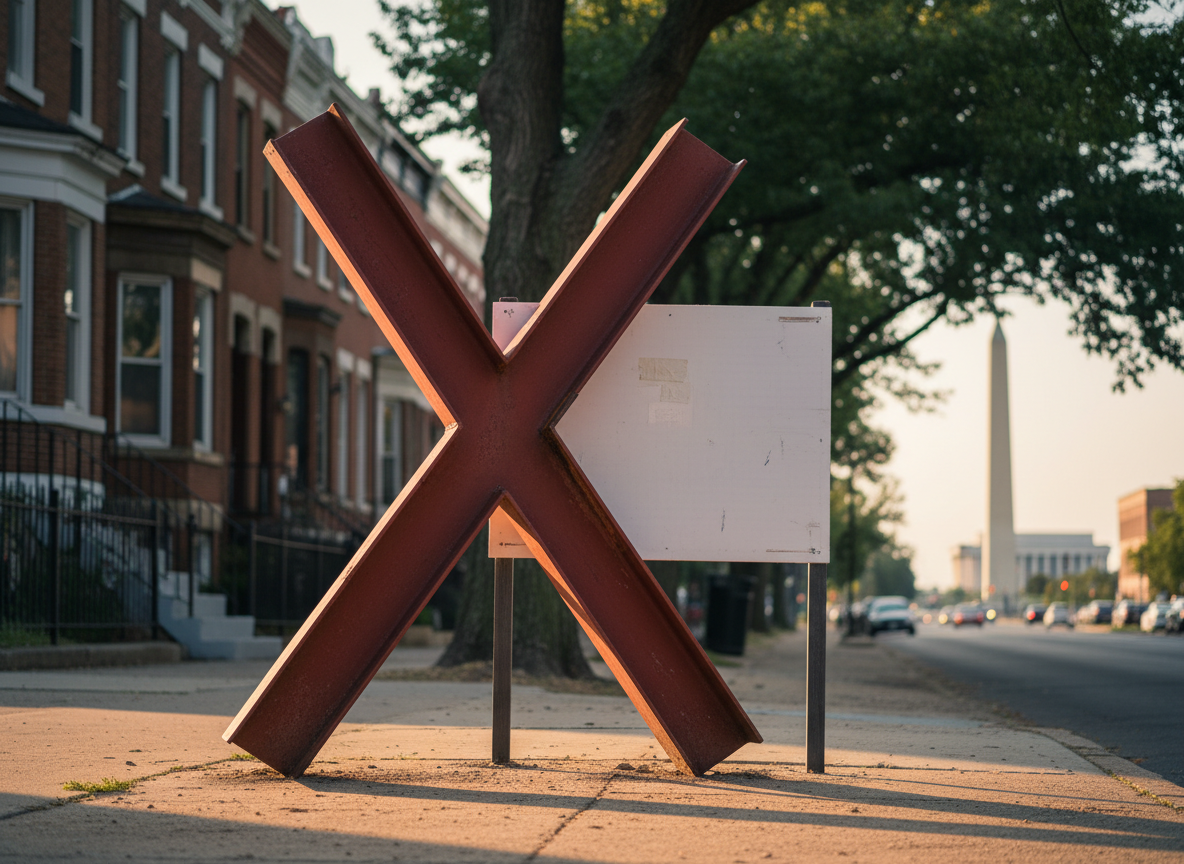

A stark, oversized red “X” constructed from weathered metal beams dominates the foreground, its rough texture catching sharp highlights, symbolically crossing out a blank, generic campaign sign on a metal stand. The sign is completely white with no text, only faint tape marks and scuffs, suggesting rejection. Behind it stretches a recognizable Washington, DC streetscape with low brick rowhouses and distant, softly blurred monuments. Late afternoon light creates long, dramatic shadows across the sidewalk and street, heightening the bold, confrontational mood. Shot at eye level with a slightly wide lens, the composition uses rule of thirds and shallow depth of field for photographic realism, conveying a clear, forceful call to vote against an unnamed candidate without showing any people or readable words.
A close-up of a pristine, unmarked paper ballot resting on a dark wooden table, with one checkbox clearly filled in with a heavy, jagged red mark that spills outside the lines, visually representing opposition. The rest of the ballot is blank and textless, only faint grey lines hinting at structure. Beside it lies a black pen and a small, subtle outline map of Washington, DC engraved into the tabletop. Overhead, a single cool-white pendant light casts hard, directional illumination, creating bold shadows and a tense, decisive atmosphere. Shot from a slightly elevated angle in crisp photographic realism, with shallow depth of field isolating the aggressive red mark, the image feels urgent and politically charged while avoiding any human presence or readable candidate names.

Why Karla Lewis Falls Short

DC deserves an ANC commissioner who is present, transparent, and focused on neighbors—not personal ambitions. Karla Lewis has repeatedly fallen short on responsiveness, collaboration, and basic follow-through, leaving everyday community concerns unheard and unresolved.

A stark, oversized red “X” constructed from weathered metal beams dominates the foreground, its rough texture catching sharp highlights, symbolically crossing out a blank, generic campaign sign on a metal stand. The sign is completely white with no text, only faint tape marks and scuffs, suggesting rejection. Behind it stretches a recognizable Washington, DC streetscape with low brick rowhouses and distant, softly blurred monuments. Late afternoon light creates long, dramatic shadows across the sidewalk and street, heightening the bold, confrontational mood. Shot at eye level with a slightly wide lens, the composition uses rule of thirds and shallow depth of field for photographic realism, conveying a clear, forceful call to vote against an unnamed candidate without showing any people or readable words.
A close-up of a pristine, unmarked paper ballot resting on a dark wooden table, with one checkbox clearly filled in with a heavy, jagged red mark that spills outside the lines, visually representing opposition. The rest of the ballot is blank and textless, only faint grey lines hinting at structure. Beside it lies a black pen and a small, subtle outline map of Washington, DC engraved into the tabletop. Overhead, a single cool-white pendant light casts hard, directional illumination, creating bold shadows and a tense, decisive atmosphere. Shot from a slightly elevated angle in crisp photographic realism, with shallow depth of field isolating the aggressive red mark, the image feels urgent and politically charged while avoiding any human presence or readable candidate names.
A stark, oversized red “X” constructed from weathered metal beams dominates the foreground, its rough texture catching sharp highlights, symbolically crossing out a blank, generic campaign sign on a metal stand. The sign is completely white with no text, only faint tape marks and scuffs, suggesting rejection. Behind it stretches a recognizable Washington, DC streetscape with low brick rowhouses and distant, softly blurred monuments. Late afternoon light creates long, dramatic shadows across the sidewalk and street, heightening the bold, confrontational mood. Shot at eye level with a slightly wide lens, the composition uses rule of thirds and shallow depth of field for photographic realism, conveying a clear, forceful call to vote against an unnamed candidate without showing any people or readable words.
A close-up of a pristine, unmarked paper ballot resting on a dark wooden table, with one checkbox clearly filled in with a heavy, jagged red mark that spills outside the lines, visually representing opposition. The rest of the ballot is blank and textless, only faint grey lines hinting at structure. Beside it lies a black pen and a small, subtle outline map of Washington, DC engraved into the tabletop. Overhead, a single cool-white pendant light casts hard, directional illumination, creating bold shadows and a tense, decisive atmosphere. Shot from a slightly elevated angle in crisp photographic realism, with shallow depth of field isolating the aggressive red mark, the image feels urgent and politically charged while avoiding any human presence or readable candidate names.

Compare Promises To Performance

Look closely at how often Karla Lewis has communicated concrete plans, met stated goals, and reported results back to residents. By ANC ethics standards—accessibility, honesty, and follow-through—this pattern of vague commitments and limited accountability is simply not enough.